
Follow the transformation
Split the data before fitting learned preprocessing.
Apply transformations separately by column type.
Fit preprocessing only on the training fold.
Robust Scaling is a preprocessing operation that changes feature representation before modelling.
Robust Scaling is a preprocessing operation that changes feature representation before modelling. Preprocessing is part of the learned pipeline because statistics such as means, categories or quantiles must be estimated on training data and then applied unchanged to validation/test data.
Robust Scaling matters because preprocessing defines the representation a model actually sees. Learned transformations must be fitted inside the training boundary so their parameters do not leak information from validation or test cases.
Treat this as a sequence of observable decisions rather than one opaque command. Stage 1: Split the data before fitting learned preprocessing. Stage 2: Apply transformations separately by column type. Stage 3: Fit preprocessing only on the training fold. Final checkpoint: Bundle preprocessing and estimator in one pipeline so cross-validation repeats the correct sequence automatically.
Split the data before fitting learned preprocessing.
Apply transformations separately by column type.
Fit preprocessing only on the training fold.
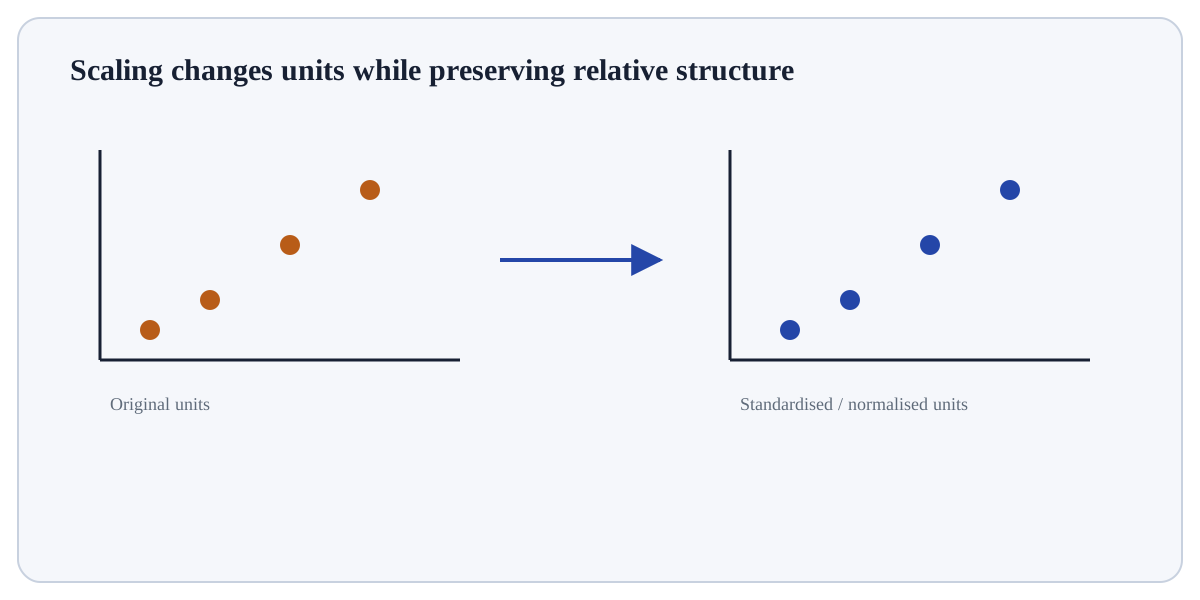
Split the data before fitting learned preprocessing. At this stage of Robust Scaling, keep the incoming data or object separate from the learned parameter, transformed object, or statistic so the change can be reproduced and independently checked.
# Step 1 — Import the module so its functions/classes are available to the rest of this example.
import numpy as np
# Step 2 — Import only the named objects needed by the following steps, keeping dependencies explicit.
from sklearn.preprocessing import StandardScaler
# Step 3 — Construct `X` as an array so vectorised numerical operations can be applied consistently.
X=np.array([[20,1000],[30,1100],[40,1200]],dtype=float)
# Step 4 — Fit the transformation on the training input and immediately transform that same input.
Z=StandardScaler().fit_transform(X)
# Step 5 — Display the current value explicitly so the result/state can be inspected during execution.
print(np.round(Z,2))Both features become centred with comparable standardised scale, preventing the large numeric unit from dominating Euclidean distance or gradient geometry.
For Robust Scaling, trace representative source rows/columns into the result and reconcile row counts, dtypes, keys or missing values that the operation could change.
Standardisation(x - training mean) / training standard deviation.Robust scalingUses median and quantile range; less influenced by extremes.One-hot encodingCreates indicator columns for categories without imposing numeric order.PipelineChains preprocessing and estimator so fitting/evaluation stay leakage-safe.Use Robust Scaling when the model/analysis requires a deliberate representation of raw features and the transformation can be fit without leaking future or held-out information.
Avoid transformations that are unnecessary for the chosen model, cannot be reproduced at inference time, or learn from data that should remain held out.
Build a tiny, inspectable example of Robust Scaling. First split the data before fitting learned preprocessing. Then apply transformations separately by column type. Write the expected result before running it, and explain one condition that would make the result misleading or invalid.
Before trusting a result from Robust Scaling, which check provides the strongest evidence that you understand and applied it correctly?
Step 1Split the data before fitting learned preprocessing.Step 2Apply transformations separately by column type.Step 3Fit preprocessing only on the training fold.Step 4Transform validation/test with the stored training parameters.