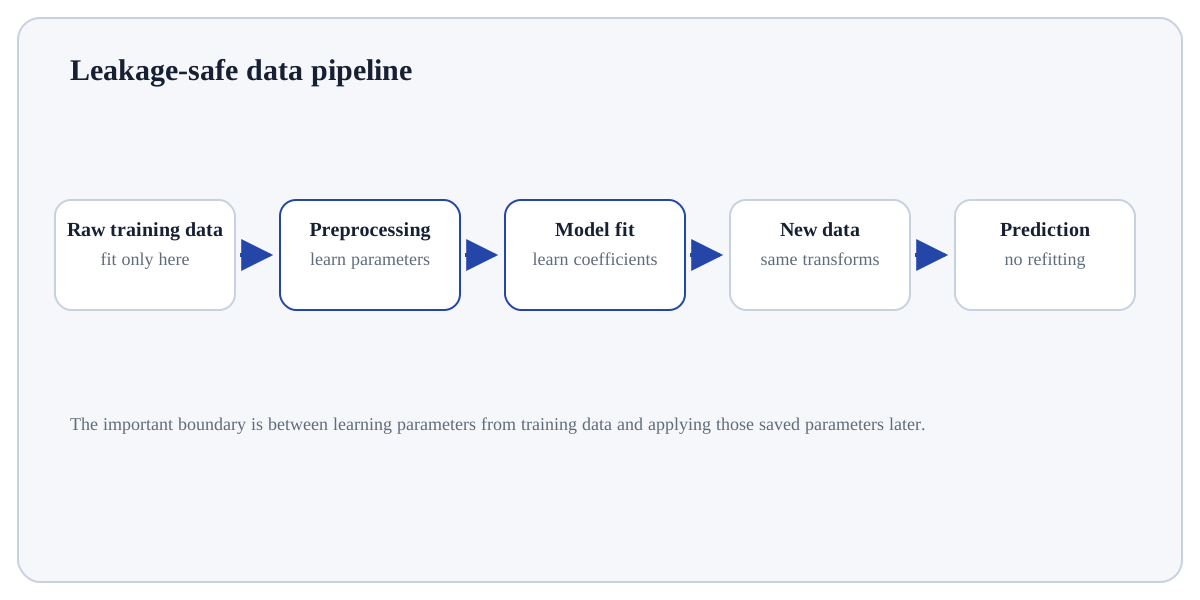
A leakage-safe pipeline treats preprocessing, feature selection and model fitting as one procedure that is refit independently inside each training fold.
ConceptWorked examplePracticeKnowledge check
Textbook walkthrough
What Leakage Safe Pipelines actually means
A leakage-safe pipeline treats preprocessing, feature selection and model fitting as one procedure that is refit independently inside each training fold. Any step that learns from data must estimate its parameters only from the fold’s training rows, then apply those frozen parameters to validation rows.
This matters because fitting a scaler, imputer, encoder or selector on the full dataset allows validation information to influence the trained procedure before evaluation, producing optimistic performance.
Deeper walkthrough
Read Leakage Safe Pipelines as a mechanism, not a recipe
Treat this as a sequence of observable decisions rather than one opaque command. Stage 1: Split or create cross-validation folds before fitting learned transformations. Stage 2: Fit imputation, scaling, encoding and feature selection on training rows only. Stage 3: Transform validation rows with the parameters learned from training. Final checkpoint: Use a Pipeline/ColumnTransformer so the entire sequence is repeated correctly in every fold.
Mechanism
Follow the transformation
Split or create cross-validation folds before fitting learned transformations.
Fit imputation, scaling, encoding and feature selection on training rows only.
Transform validation rows with the parameters learned from training.
Evidence
Know what would convince you
Write down the prediction unit and which records are allowed to coexist across train/validation/test before splitting.
Inspect fold/group/time indices directly and assert that forbidden overlap is zero.
Useful distinctionUnsafe preprocessing: Fit transformer once on all data, then cross-validate the model.
Visual demonstration: use the diagram to trace the main objects and state changes involved in Leakage Safe Pipelines.
Click a stage to inspect what happens, what changes, and what should be checked before moving on.
Stage 1
Split or create cross-validation folds before…
Split or create cross-validation folds before fitting learned transformations. At this stage of Leakage Safe Pipelines, keep the incoming data or object separate from the learned parameter, transformed object, or statistic so the change can be reproduced and independently checked.
Transformation focus: keep the input and produced parameters/result separate so the change is observable and reproducible.
How it works
Trace the mechanism step by step
Split or create cross-validation folds before fitting learned transformations.
Fit imputation, scaling, encoding and feature selection on training rows only.
Transform validation rows with the parameters learned from training.
Fit the estimator on the transformed training rows and score transformed validation rows.
Use a Pipeline/ColumnTransformer so the entire sequence is repeated correctly in every fold.
Worked demonstration
Make the concept concrete
Demonstration
Python / scikit-learn example
# Step 1 — Import only the named objects needed by the following steps, keeping dependencies explicit.
from sklearn.pipeline import Pipeline
# Step 2 — Import only the named objects needed by the following steps, keeping dependencies explicit.
from sklearn.preprocessing import StandardScaler
# Step 3 — Import only the named objects needed by the following steps, keeping dependencies explicit.
from sklearn.linear_model import LogisticRegression
# Step 4 — Create `pipe` as the scaling object; its parameters will be learned from training data.
pipe = Pipeline([("scale", StandardScaler()), ("model", LogisticRegression())])
# Step 5 — Display the current value explicitly so the result/state can be inspected during execution.
print(pipe)
Expected / illustrative result
The scaler and model are coupled so cross-validation fits both using training rows from each fold only.
Interpret the result.
For Leakage Safe Pipelines, connect the reported result to the exact training/validation/prediction step that produced it and check one prediction, fold or metric component independently.
Distinctions & related ideas
Know what this is — and what it is not
Unsafe preprocessingFit transformer once on all data, then cross-validate the model.
Leakage-safe pipelineTransformer + model are refit inside every training fold.
Test setRemains untouched until model selection is complete.
Use deliberately
When it is appropriate
Use Leakage Safe Pipelines when it reflects how genuinely unseen cases will arrive and keeps every learned choice inside the training portion of each evaluation split.
Boundary conditions
When to stop or reconsider
Choose a different split strategy when observations share subjects/groups, have temporal order, or otherwise violate independent random splitting assumptions.
Common mistakes
Failure modes to recognise
Letting the final test set influence feature engineering, model choice, tuning or threshold selection.
Splitting related groups or future/past records in a way that leaks information across folds.
Reporting one lucky split without examining variability or preserving the exact split logic.
Verification
How to check the result
Write down the prediction unit and which records are allowed to coexist across train/validation/test before splitting.
Inspect fold/group/time indices directly and assert that forbidden overlap is zero.
Run preprocessing/tuning inside each training fold and reserve the final test set for one final evaluation.
Hands-on practice
Demonstrate understanding
Try this:
Build a tiny, inspectable example of Leakage Safe Pipelines. First split or create cross-validation folds before fitting learned transformations. Then fit imputation, scaling, encoding and feature selection on training rows only. Write the expected result before running it, and explain one condition that would make the result misleading or invalid.
Draw the rows/groups/times as blocks and label exactly which block trains, validates and tests each step. Check for any information path crossing the boundary.
Knowledge check
Check reasoning, not memorisation
Before trusting a result from Leakage Safe Pipelines, which check provides the strongest evidence that you understand and applied it correctly?
Quick reference
Keep the important distinctions visible
Step 1Split or create cross-validation folds before fitting learned transformations.
Step 2Fit imputation, scaling, encoding and feature selection on training rows only.
Step 3Transform validation rows with the parameters learned from training.
Step 4Fit the estimator on the transformed training rows and score transformed validation rows.
Lesson summary
What to remember
Leakage Safe Pipelines belongs to Python code organisation and dependency management. Modules split source into importable files, packages group modules, virtual environments isolate dependencies, and requirement metadata makes the software environment reproducible.
Split or create cross-validation folds before fitting learned transformations.
Letting the final test set influence feature engineering, model choice, tuning or threshold selection.
Write down the prediction unit and which records are allowed to coexist across train/validation/test before splitting.