
Follow the transformation
Draw bootstrap samples for individual trees.
At each split, consider a random subset of features.
Grow many trees with controlled hyperparameters.
A random forest averages many decision trees built from resampled observations and randomly restricted feature candidates.
A random forest averages many decision trees built from resampled observations and randomly restricted feature candidates. The diversity between trees reduces the variance of a single tree while retaining nonlinear interactions and threshold behaviour.
Learning goal: explain why Random Forest behaves this way, apply it to a small example, and verify the result independently. Begin by being able to justify this first step: Draw bootstrap samples for individual trees.
Treat this as a sequence of observable decisions rather than one opaque command. Stage 1: Draw bootstrap samples for individual trees. Stage 2: At each split, consider a random subset of features. Stage 3: Grow many trees with controlled hyperparameters. Final checkpoint: Use out-of-bag/validation evidence and interpret impurity importances cautiously.
Draw bootstrap samples for individual trees.
At each split, consider a random subset of features.
Grow many trees with controlled hyperparameters.
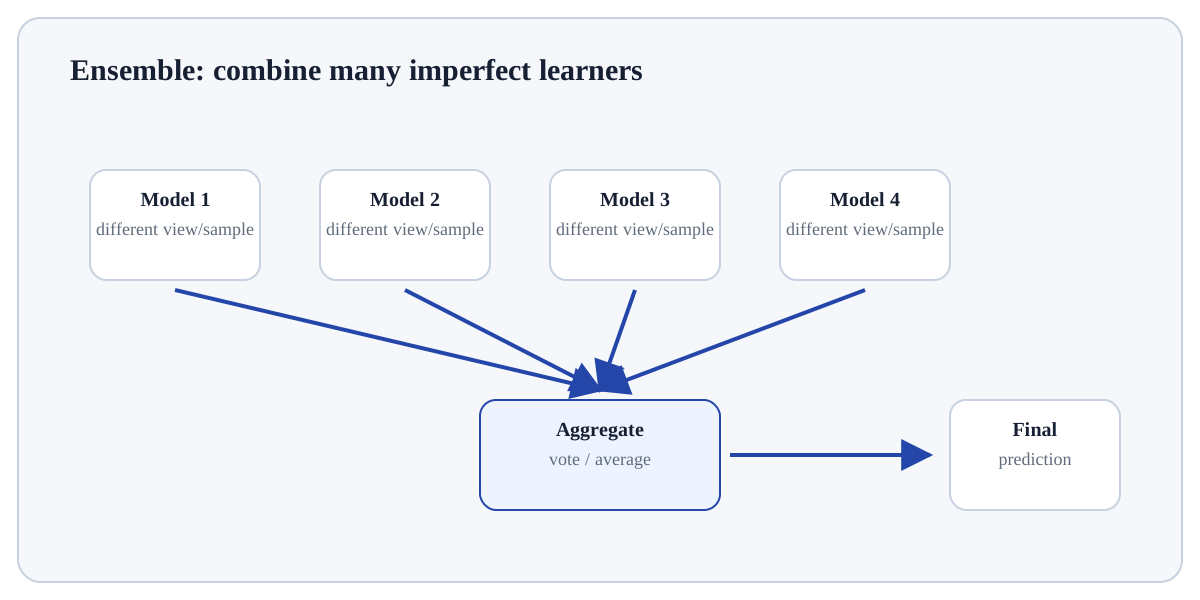
Draw bootstrap samples for individual trees. For Random Forest, identify the exact state before this stage, the operation or rule applied here, and the observable state afterwards so the mechanism remains inspectable.
Tree votes: [A, A, B, A, B] → forest prediction A.No single tree controls the result; aggregation stabilises predictions across varied training samples/features.
For Random Forest, connect the result to the fitted state, held-out data or prediction rule that produced it and independently check one prediction, split or metric component.
Training evidenceInformation allowed to influence fitted state.Held-out evidenceIndependent observations used to estimate generalisation.InterpretationWhat the result supports, with assumptions and limitations.Use Random Forest when it answers a defined question in Predictive Modelling and its inputs/assumptions match the current data or program state.
Reconsider Random Forest when the required information is unavailable, the operation would violate a validation/data boundary, or a simpler operation answers the question more transparently.
Construct a tiny example of Random Forest. First draw bootstrap samples for individual trees. Then at each split, consider a random subset of features. Predict the result before execution and explain one boundary or failure case.
Which approach best demonstrates understanding of Random Forest?
Step 1Draw bootstrap samples for individual trees.Step 2At each split, consider a random subset of features.Step 3Grow many trees with controlled hyperparameters.Step 4Average predictions or majority-vote classes.