
Follow the transformation
Define each example, feature vector and target (if supervised).
Choose a model family with parameters learned from training data.
Choose hyperparameters through a validation process rather than from test performance.
Training Validation and Inference is a machine-learning foundation.
Training Validation and Inference is a machine-learning foundation. A learning algorithm uses examples to estimate model parameters; the goal is not to memorise the training set but to generalise to new observations drawn from the intended deployment process.
Training Validation and Inference matters because machine learning is a procedure for generalising from examples, not merely fitting an algorithm. Features, targets, parameters, hyperparameters and validation each play different roles in that procedure.
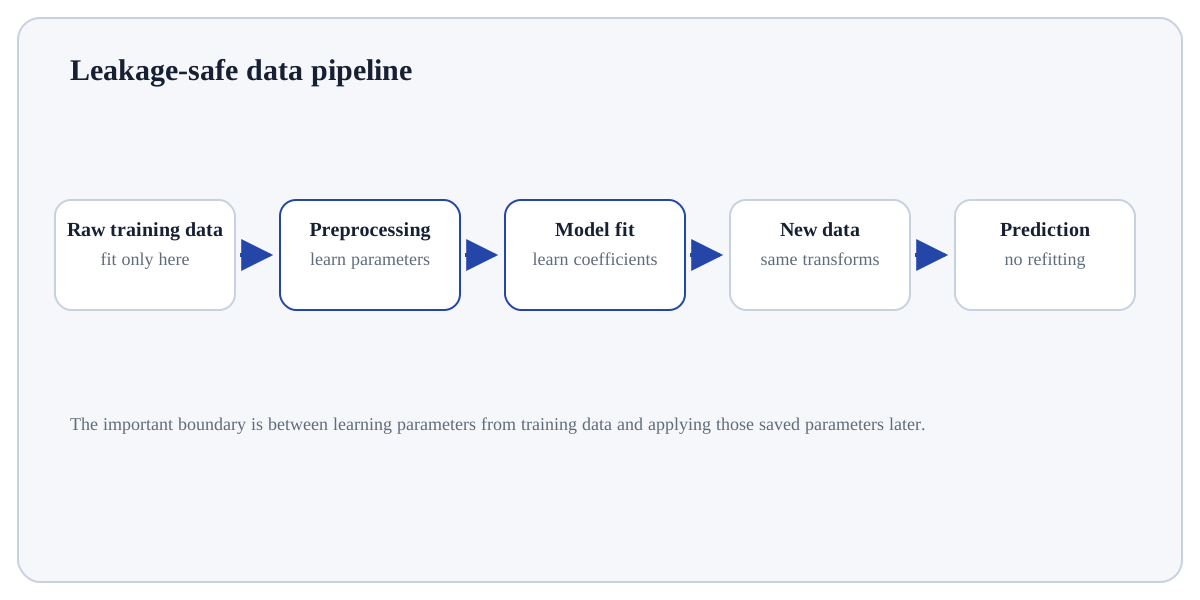
Treat this as a sequence of observable decisions rather than one opaque command. Stage 1: Define each example, feature vector and target (if supervised). Stage 2: Choose a model family with parameters learned from training data. Stage 3: Choose hyperparameters through a validation process rather than from test performance. Final checkpoint: Use the frozen fitted pipeline for inference on new data.
Define each example, feature vector and target (if supervised).
Choose a model family with parameters learned from training data.
Choose hyperparameters through a validation process rather than from test performance.
Define each example, feature vector and target (if supervised). This is an input-preparation stage for Training Validation and Inference. Verify the relevant type, shape, units, keys, missingness or assumptions before later steps depend on them.
Training: estimate model parameters from training examples.
Validation: choose model/hyperparameters/threshold without touching final test data.
Inference: freeze the fitted pipeline and apply it to new records.Mixing these phases makes offline performance optimistic and deployment behaviour hard to reproduce.
For Training Validation and Inference, connect the reported result to the exact training/validation/prediction step that produced it and check one prediction, fold or metric component independently.
Feature XInput information available to the model.Target yOutcome to predict in supervised learning.ParameterLearned during fitting, e.g. regression coefficients.HyperparameterSet outside the fitting step, e.g. tree depth.InferenceApplying a fitted model to new examples.Use Training Validation and Inference when its inductive assumptions fit the feature/target structure and it can be compared fairly with a simpler baseline on unseen data.
Prefer a simpler or different model when the sample size, representation, computational budget, interpretability requirement or data geometry conflicts with this method.
Build a tiny, inspectable example of Training Validation and Inference. First define each example, feature vector and target (if supervised). Then choose a model family with parameters learned from training data. Write the expected result before running it, and explain one condition that would make the result misleading or invalid.
Before trusting a result from Training Validation and Inference, which check provides the strongest evidence that you understand and applied it correctly?
Step 1Define each example, feature vector and target (if supervised).Step 2Choose a model family with parameters learned from training data.Step 3Choose hyperparameters through a validation process rather than from test performance.Step 4Fit on training data and evaluate on independent validation/test data.