
Follow the transformation
Align feature and weight vectors with the same dimension.
Multiply corresponding components.
Sum those products to obtain the linear score.
The dot product multiplies corresponding vector components and sums them: x·w = Σ x_j w_j.
The dot product multiplies corresponding vector components and sums them: x·w = Σ x_j w_j. Linear models use this operation to turn a feature vector into a scalar score. Adding an intercept gives an affine prediction, and each weight controls how its feature contributes when other inputs are held fixed.
Learning goal: explain why Dot Products and Linear Functions behaves this way, apply it to a small example, and verify the result independently. Begin by being able to justify this first step: Align feature and weight vectors with the same dimension.
Treat this as a sequence of observable decisions rather than one opaque command. Stage 1: Align feature and weight vectors with the same dimension. Stage 2: Multiply corresponding components. Stage 3: Sum those products to obtain the linear score. Final checkpoint: Interpret sign and magnitude only in the context of feature scale and model assumptions.
Align feature and weight vectors with the same dimension.
Multiply corresponding components.
Sum those products to obtain the linear score.
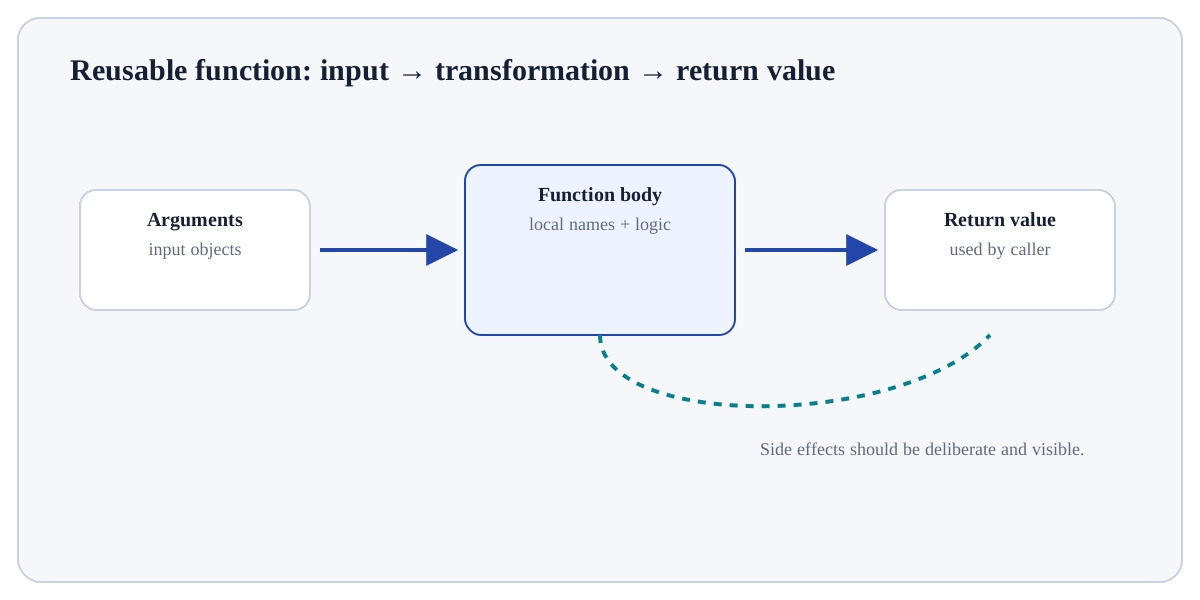
Align feature and weight vectors with the same dimension. For Dot Products and Linear Functions, identify the exact state before this stage, the operation or rule applied here, and the observable state afterwards so the mechanism remains inspectable.
# Step 1 — Compute the right-hand expression and store its result in `x` for the next step.
x = [2, 3]
# Step 2 — Compute the right-hand expression and store its result in `w` for the next step.
w = [0.5, -1]
# Step 3 — Compute the right-hand expression and store its result in `score` for the next step.
score = 2*0.5 + 3*(-1)
# Step 4 — Display the current value explicitly so the result/state can be inspected during execution.
print(score)The dot product is -2.0; an intercept b would shift the final linear function to b - 2.0.
For Dot Products and Linear Functions, identify exactly what each reported quantity represents, including its units/denominator, and independently recompute one part of the result.
RepresentationHow the method encodes inputs/predictions.Learning/operationWhat fitted state or calculation changes.ValidationIndependent evidence used to judge generalisation or correctness.Use Dot Products and Linear Functions when it answers a defined question in Math for ML and its inputs/assumptions match the current data or program state.
Reconsider Dot Products and Linear Functions when the required information is unavailable, the operation would violate a validation/data boundary, or a simpler operation answers the question more transparently.
Construct a tiny example of Dot Products and Linear Functions. First align feature and weight vectors with the same dimension. Then multiply corresponding components. Predict the result before execution and explain one boundary or failure case.
Which approach best demonstrates understanding of Dot Products and Linear Functions?
Step 1Align feature and weight vectors with the same dimension.Step 2Multiply corresponding components.Step 3Sum those products to obtain the linear score.Step 4Add an intercept when the model includes one.