
Follow the transformation
Fit scaling parameters on training data only.
Transform training and held-out data with the same fitted scaler.
Choose standard, min-max or robust scaling based on model/data characteristics.
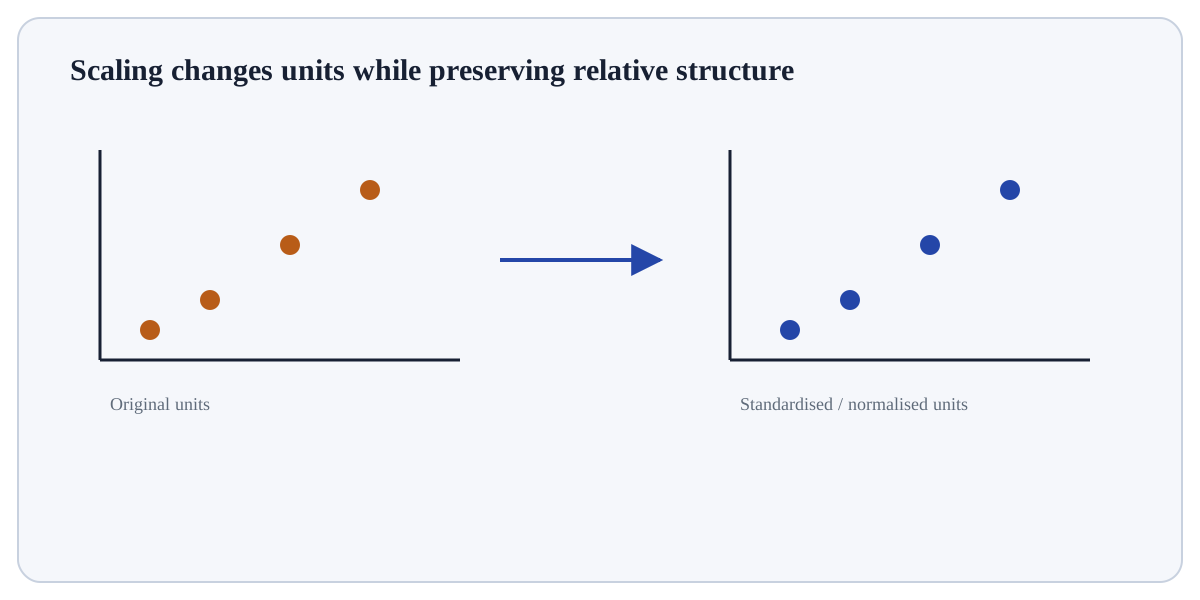
Numeric scaling changes feature units without changing the ordering of observations.
Numeric scaling changes feature units without changing the ordering of observations. Standardisation subtracts the training mean and divides by the training standard deviation; other scalers use ranges or robust quantiles. Scaling is important for methods whose geometry or optimisation depends on feature magnitude, such as KNN, SVMs, PCA and many gradient-based models.
Learning goal: explain why Numeric Scaling behaves this way, apply it to a small example, and verify the result independently. Begin by being able to justify this first step: Fit scaling parameters on training data only.
Treat this as a sequence of observable decisions rather than one opaque command. Stage 1: Fit scaling parameters on training data only. Stage 2: Transform training and held-out data with the same fitted scaler. Stage 3: Choose standard, min-max or robust scaling based on model/data characteristics. Final checkpoint: Place learned scaling inside the validation pipeline.
Fit scaling parameters on training data only.
Transform training and held-out data with the same fitted scaler.
Choose standard, min-max or robust scaling based on model/data characteristics.
Fit scaling parameters on training data only. At this stage of Numeric Scaling, keep the incoming data or object separate from the learned parameter, transformed object, or statistic so the change can be reproduced and independently checked.
Values: [10, 20, 30]
Mean = 20, standard deviation ≈ 8.16
Scaled ≈ [-1.225, 0, 1.225]The relative positions remain, but the feature is recentered and expressed in standard-deviation units.
For Numeric Scaling, connect the result to the fitted state, held-out data or prediction rule that produced it and independently check one prediction, split or metric component.
RepresentationHow the method encodes inputs/predictions.Learning/operationWhat fitted state or calculation changes.ValidationIndependent evidence used to judge generalisation or correctness.Use Numeric Scaling when it answers a defined question in Data Preparation for ML and its inputs/assumptions match the current data or program state.
Reconsider Numeric Scaling when the required information is unavailable, the operation would violate a validation/data boundary, or a simpler operation answers the question more transparently.
Construct a tiny example of Numeric Scaling. First fit scaling parameters on training data only. Then transform training and held-out data with the same fitted scaler. Predict the result before execution and explain one boundary or failure case.
Which approach best demonstrates understanding of Numeric Scaling?
Step 1Fit scaling parameters on training data only.Step 2Transform training and held-out data with the same fitted scaler.Step 3Choose standard, min-max or robust scaling based on model/data characteristics.Step 4Do not expect scaling to fix skewness, outliers or semantic data errors by itself.