
Follow the transformation
Compute linear score z = β0 + βᵀx.
Map z through sigmoid p = 1/(1+e^-z) for binary classification.
Fit coefficients by minimising log loss / maximising likelihood, often with regularisation.
Logistic regression is a linear probabilistic classifier.
Logistic regression is a linear probabilistic classifier. It forms a linear score from the features and maps that score through the logistic function to a probability for the positive class. Multiclass softmax generalises the idea to a probability distribution across classes.
Logistic Regression matters because linear models provide an interpretable baseline and expose central ideas such as coefficient estimation, probability links and regularisation. They also show clearly how preprocessing and penalty choices affect fitted parameters.
Treat this as a sequence of observable decisions rather than one opaque command. Stage 1: Compute linear score z = β0 + βᵀx. Stage 2: Map z through sigmoid p = 1/(1+e^-z) for binary classification. Stage 3: Fit coefficients by minimising log loss / maximising likelihood, often with regularisation. Final checkpoint: Evaluate discrimination and calibration separately.
Compute linear score z = β0 + βᵀx.
Map z through sigmoid p = 1/(1+e^-z) for binary classification.
Fit coefficients by minimising log loss / maximising likelihood, often with regularisation.
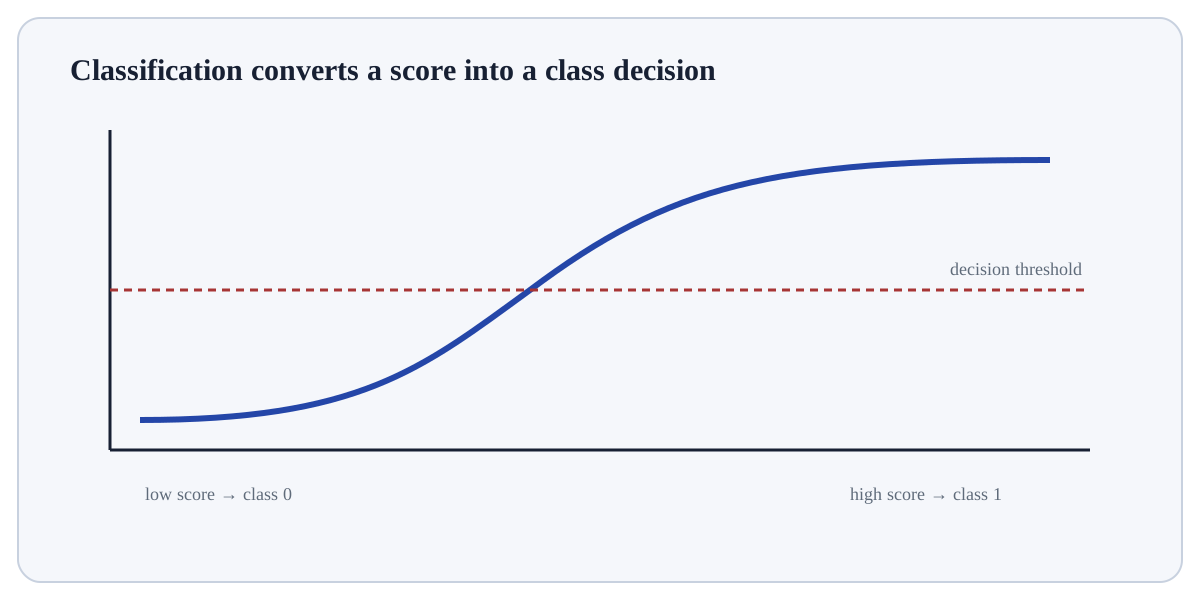
Compute linear score z = β0 + βᵀx. At this stage of Logistic Regression, keep the incoming data or object separate from the learned parameter, transformed object, or statistic so the change can be reproduced and independently checked.
# Step 1 — Import the module so its functions/classes are available to the rest of this example.
import numpy as np
# Step 2 — Import only the named objects needed by the following steps, keeping dependencies explicit.
from sklearn.linear_model import LogisticRegression
# Step 3 — Construct `X` as an array so vectorised numerical operations can be applied consistently.
X=np.array([[0],[1],[2],[3],[4],[5]])
# Step 4 — Construct `y` as an array so vectorised numerical operations can be applied consistently.
y=np.array([0,0,0,1,1,1])
# Step 5 — Fit the model or transformer, learning its parameters from the supplied training data.
m=LogisticRegression().fit(X,y)
# Step 6 — Display the current value explicitly so the result/state can be inspected during execution.
print(np.round(m.predict_proba([[2.0],[4.0]])[:,1],3))The probability at x=4 is higher than at x=2; a later threshold converts probabilities into class decisions.
For Logistic Regression, connect the reported result to the exact training/validation/prediction step that produced it and check one prediction, fold or metric component independently.
Linear regressionContinuous prediction with unbounded output.Logistic regressionBinary class probability via sigmoid.Softmax regressionMulticlass probabilities summing to 1.ThresholdDecision rule applied after probability estimation; not part of probability fitting itself.Use Logistic Regression when its inductive assumptions fit the feature/target structure and it can be compared fairly with a simpler baseline on unseen data.
Prefer a simpler or different model when the sample size, representation, computational budget, interpretability requirement or data geometry conflicts with this method.
Build a tiny, inspectable example of Logistic Regression. First compute linear score z = β0 + βᵀx. Then map z through sigmoid p = 1/(1+e^-z) for binary classification. Write the expected result before running it, and explain one condition that would make the result misleading or invalid.
Before trusting a result from Logistic Regression, which check provides the strongest evidence that you understand and applied it correctly?
Step 1Compute linear score z = β0 + βᵀx.Step 2Map z through sigmoid p = 1/(1+e^-z) for binary classification.Step 3Fit coefficients by minimising log loss / maximising likelihood, often with regularisation.Step 4Convert probability to a class using a threshold chosen for the decision context.