
Follow the transformation
Scale/transform features so distances reflect meaningful comparability.
Compute distance from the query point to training samples.
Select the k nearest neighbours.
KNN Regression belongs to distance-based learning.
KNN Regression belongs to distance-based learning. K-nearest neighbours makes predictions from training examples close to the query under a chosen distance metric, so feature scale and the meaning of distance are central assumptions.
KNN Regression matters because instance- and kernel-based methods depend directly on distance, margin or similarity geometry. Feature scale and hyperparameters can therefore change which observations are considered close or which boundary is preferred.
Treat this as a sequence of observable decisions rather than one opaque command. Stage 1: Scale/transform features so distances reflect meaningful comparability. Stage 2: Compute distance from the query point to training samples. Stage 3: Select the k nearest neighbours. Final checkpoint: Choose k and distance settings using validation.
Scale/transform features so distances reflect meaningful comparability.
Compute distance from the query point to training samples.
Select the k nearest neighbours.
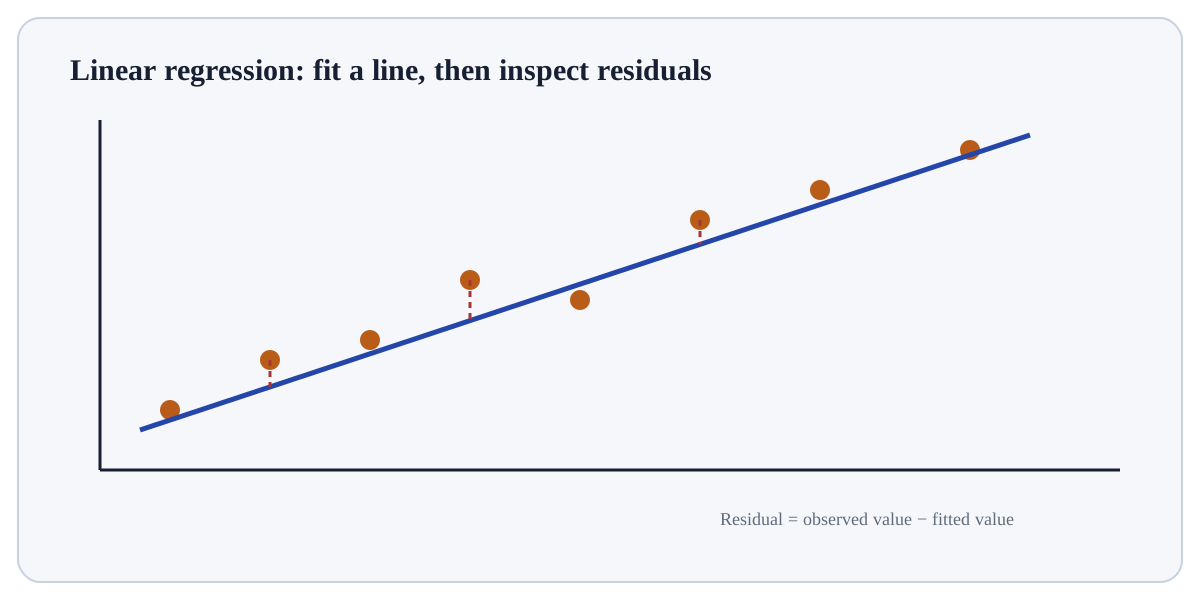
Scale/transform features so distances reflect meaningful comparability. At this stage of KNN Regression, keep the incoming data or object separate from the learned parameter, transformed object, or statistic so the change can be reproduced and independently checked.
# Step 1 — Import the module so its functions/classes are available to the rest of this example.
import numpy as np
# Step 2 — Import only the named objects needed by the following steps, keeping dependencies explicit.
from sklearn.neighbors import KNeighborsClassifier
# Step 3 — Construct `X` as an array so vectorised numerical operations can be applied consistently.
X=np.array([[0],[1],[4],[5]])
# Step 4 — Construct `y` as an array so vectorised numerical operations can be applied consistently.
y=np.array([0,0,1,1])
# Step 5 — Fit the model or transformer, learning its parameters from the supplied training data.
m=KNeighborsClassifier(n_neighbors=3).fit(X,y)
# Step 6 — Display the current value explicitly so the result/state can be inspected during execution.
print(m.predict([[3.8]])[0])1 The query is closer to the positive training neighbourhood under the chosen distance and k.
For KNN Regression, connect the reported result to the exact training/validation/prediction step that produced it and check one prediction, fold or metric component independently.
Small kFlexible/local, lower bias and higher variance.Large kSmoother, higher bias and lower variance.Euclidean distanceStraight-line distance; sensitive to scale.Manhattan distanceSum of absolute coordinate differences.Use KNN Regression when its inductive assumptions fit the feature/target structure and it can be compared fairly with a simpler baseline on unseen data.
Prefer a simpler or different model when the sample size, representation, computational budget, interpretability requirement or data geometry conflicts with this method.
Build a tiny, inspectable example of KNN Regression. First scale/transform features so distances reflect meaningful comparability. Then compute distance from the query point to training samples. Write the expected result before running it, and explain one condition that would make the result misleading or invalid.
Before trusting a result from KNN Regression, which check provides the strongest evidence that you understand and applied it correctly?
Step 1Scale/transform features so distances reflect meaningful comparability.Step 2Compute distance from the query point to training samples.Step 3Select the k nearest neighbours.Step 4Classification uses a vote/probability from neighbour labels; regression averages (or weights) neighbour targets.