
Follow the transformation
Start with all training samples at the root.
Evaluate candidate feature splits.
Choose a split that most reduces impurity/error.
Pruning and Depth is part of decision-tree learning.
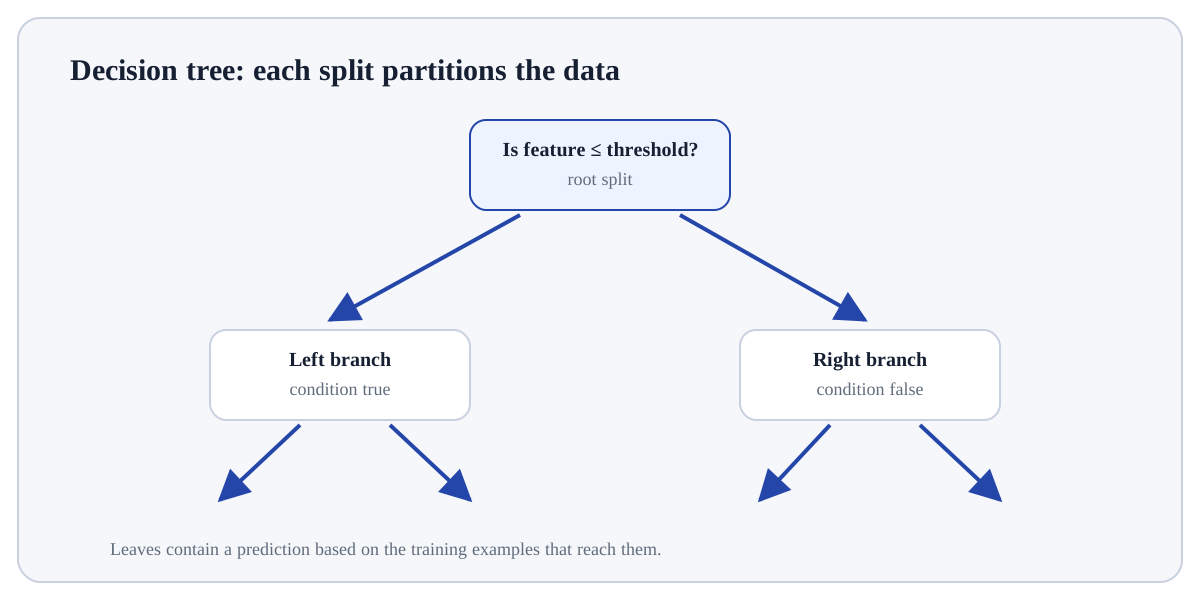
Pruning and Depth is part of decision-tree learning. A tree recursively partitions feature space using threshold/category splits chosen to improve node purity or reduce prediction error; terminal leaves store class distributions or numeric predictions.
Pruning and Depth matters because tree models learn nonlinear threshold rules and interactions with little preprocessing, but unconstrained trees can have high variance. Ensembles and pruning trade interpretability, variance and computational cost in different ways.
Treat this as a sequence of observable decisions rather than one opaque command. Stage 1: Start with all training samples at the root. Stage 2: Evaluate candidate feature splits. Stage 3: Choose a split that most reduces impurity/error. Final checkpoint: Predict by following one path from root to leaf.
Start with all training samples at the root.
Evaluate candidate feature splits.
Choose a split that most reduces impurity/error.
# Step 1 — Import only the named objects needed by the following steps, keeping dependencies explicit.
from sklearn.tree import DecisionTreeClassifier, export_text
# Step 2 — Compute the right-hand expression and store its result in `X` for the next step.
X=[[20],[25],[50],[55]]; y=[0,0,1,1]
# Step 3 — Fit the model or transformer, learning its parameters from the supplied training data.
m=DecisionTreeClassifier(max_depth=1, random_state=0).fit(X,y)
# Step 4 — Display the current value explicitly so the result/state can be inspected during execution.
print(export_text(m, feature_names=["age"]))A single split around the gap between 25 and 50 separates the toy classes. Deeper trees can create more partitions and higher variance.
For Pruning and Depth, connect the reported result to the exact training/validation/prediction step that produced it and check one prediction, fold or metric component independently.
Classification treeLeaves predict classes/probabilities; split criteria include Gini/entropy.Regression treeLeaves predict numeric values; splits reduce squared/absolute error.Deep treeLow bias, high variance; can memorise training details.Pruned/shallow treeHigher bias, often better stability/generalisation.Use Pruning and Depth when its inductive assumptions fit the feature/target structure and it can be compared fairly with a simpler baseline on unseen data.
Prefer a simpler or different model when the sample size, representation, computational budget, interpretability requirement or data geometry conflicts with this method.
Build a tiny, inspectable example of Pruning and Depth. First start with all training samples at the root. Then evaluate candidate feature splits. Write the expected result before running it, and explain one condition that would make the result misleading or invalid.
Before trusting a result from Pruning and Depth, which check provides the strongest evidence that you understand and applied it correctly?
Step 1Start with all training samples at the root.Step 2Evaluate candidate feature splits.Step 3Choose a split that most reduces impurity/error.Step 4Repeat recursively in child nodes.