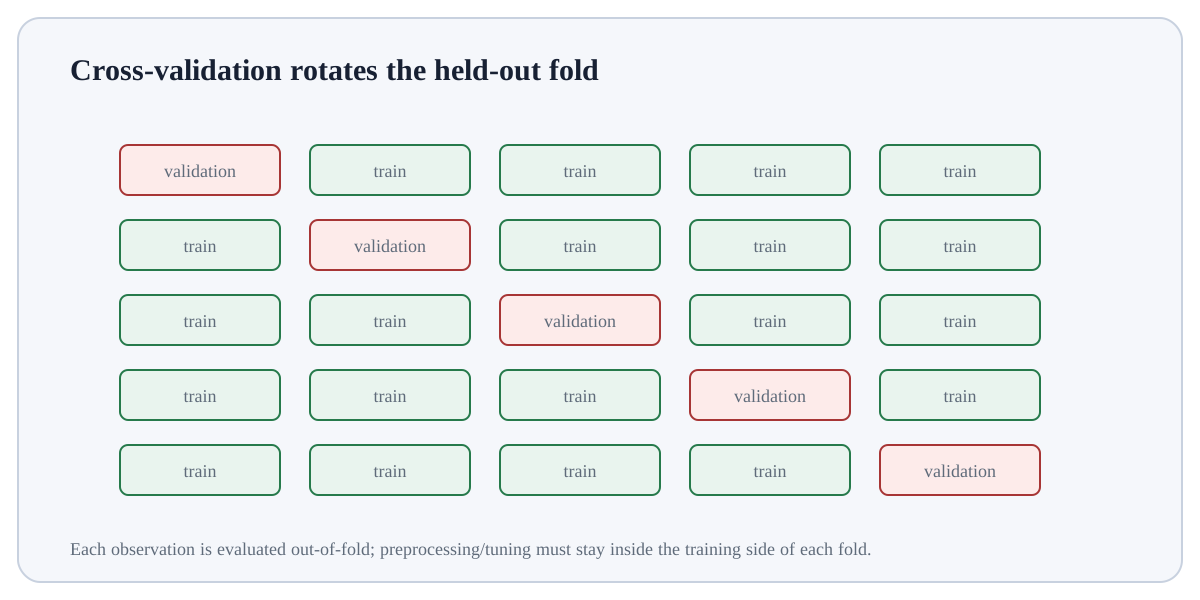
Cross-validation repeatedly trains the complete pipeline on development folds and evaluates on held-out folds to estimate variability and support model selection.
ConceptWorked examplePracticeKnowledge check
Textbook walkthrough
Cross Validate
Cross-validation repeatedly trains the complete pipeline on development folds and evaluates on held-out folds to estimate variability and support model selection. The splitter must reflect the deployment independence structure.
Learning goal: explain why Cross Validate behaves this way, apply it to a small example, and verify the result independently. Begin by being able to justify this first step: Choose KFold/Stratified/Group/TimeSeries as appropriate, cross-validate the entire pipeline and retain fold-level scores.
Deeper walkthrough
Read Cross Validate as a mechanism, not a recipe
Treat this as a sequence of observable decisions rather than one opaque command. Stage 1: Choose KFold/Stratified/Group/TimeSeries as appropriate, cross-validate the entire pipeline and retain fold-level scores. Stage 2: Keep the stage inside the same data/validation definitions used by the rest of the project. Stage 3: Save the evidence produced by this stage so the next stage can be audited.
Mechanism
Follow the transformation
Choose KFold/Stratified/Group/TimeSeries as appropriate, cross-validate the entire pipeline and retain fold-level scores.
Keep the stage inside the same data/validation definitions used by the rest of the project.
Save the evidence produced by this stage so the next stage can be audited.
Evidence
Know what would convince you
Verify the split/validation boundary before comparing scores.
Inspect model/preprocessing state or a hand-computable tiny example.
Useful distinctionRepresentation: How the method encodes inputs/predictions.
Visual demonstration: use the diagram to trace the main objects and state changes involved in Cross Validate.
Click a stage to inspect what happens, what changes, and what should be checked before moving on.
Stage 1
Choose KFold/Stratified/Group/TimeSeries as appropriate
Choose KFold/Stratified/Group/TimeSeries as appropriate, cross-validate the entire pipeline and retain fold-level scores.
Verification focus: record the evidence you inspected and the condition that would make this stage fail.
How it works
Trace the mechanism step by step
Choose KFold/Stratified/Group/TimeSeries as appropriate, cross-validate the entire pipeline and retain fold-level scores.
Keep the stage inside the same data/validation definitions used by the rest of the project.
Save the evidence produced by this stage so the next stage can be audited.
Worked demonstration
Cross Validate evidence
Cross Validate evidence
Evidence: mean plus spread and explicit fold/split logic, with no entity/time leakage.
Expected / illustrative result
The worked evidence makes the output of this project stage concrete and auditable.
Interpret the result.
For Cross Validate, trace the specific input through the mechanism above and independently verify one returned value, state change or side effect.
Distinctions & related ideas
Place the concept correctly
RepresentationHow the method encodes inputs/predictions.
Learning/operationWhat fitted state or calculation changes.
ValidationIndependent evidence used to judge generalisation or correctness.
Use deliberately
When it is appropriate
Use Cross Validate when it answers a defined question in Capstone Project and its inputs/assumptions match the current data or program state.
Boundary conditions
When to stop or reconsider
Reconsider Cross Validate when the required information is unavailable, the operation would violate a validation/data boundary, or a simpler operation answers the question more transparently.
Common mistakes
Failure modes to recognise
Optimising on the final test set.
Ignoring feature scale/representation or split structure when the method depends on them.
Reporting a single score without checking errors, variance or operating conditions.
Verification
How to check the result
Verify the split/validation boundary before comparing scores.
Inspect model/preprocessing state or a hand-computable tiny example.
Perturb one input/hyperparameter and predict the expected direction or behaviour.
Hands-on practice
Demonstrate understanding
Try this:
Construct a tiny example of Cross Validate. First choose KFold/Stratified/Group/TimeSeries as appropriate, cross-validate the entire pipeline and retain fold-level scores. Then keep the stage inside the same data/validation definitions used by the rest of the project. Predict the result before execution and explain one boundary or failure case.
List the stage inputs and expected artifact, rerun it from a clean state, and compare against a concrete acceptance check.
Knowledge check
Check reasoning, not memorisation
Which approach best demonstrates understanding of Cross Validate?
Quick reference
Remember the logic
Step 1Choose KFold/Stratified/Group/TimeSeries as appropriate, cross-validate the entire pipeline and retain fold-level scores.
Step 2Keep the stage inside the same data/validation definitions used by the rest of the project.
Step 3Save the evidence produced by this stage so the next stage can be audited.
Lesson summary
What to remember
Cross-validation repeatedly trains the complete pipeline on development folds and evaluates on held-out folds to estimate variability and support model selection. The splitter must reflect the deployment independence structure.
Choose KFold/Stratified/Group/TimeSeries as appropriate, cross-validate the entire pipeline and retain fold-level scores.
Optimising on the final test set.
Verify the split/validation boundary before comparing scores.