
Follow the transformation
State the small task and expected result before coding.
Use the concepts from this module rather than introducing unnecessary new machinery.
Inspect intermediate values on the tiny example.
This mini lab packages a KPI definition into a function so numerator, denominator and invalid-denominator handling are applied consistently wherever the metric is used.
This mini lab packages a KPI definition into a function so numerator, denominator and invalid-denominator handling are applied consistently wherever the metric is used.
Learning goal: explain why Mini Lab Reusable KPI Functions behaves this way, apply it to a small example, and verify the result independently. Begin by being able to justify this first step: State the small task and expected result before coding.
Treat this as a sequence of observable decisions rather than one opaque command. Stage 1: State the small task and expected result before coding. Stage 2: Use the concepts from this module rather than introducing unnecessary new machinery. Stage 3: Inspect intermediate values on the tiny example. Final checkpoint: Explain why the final result follows from the code.
State the small task and expected result before coding.
Use the concepts from this module rather than introducing unnecessary new machinery.
Inspect intermediate values on the tiny example.
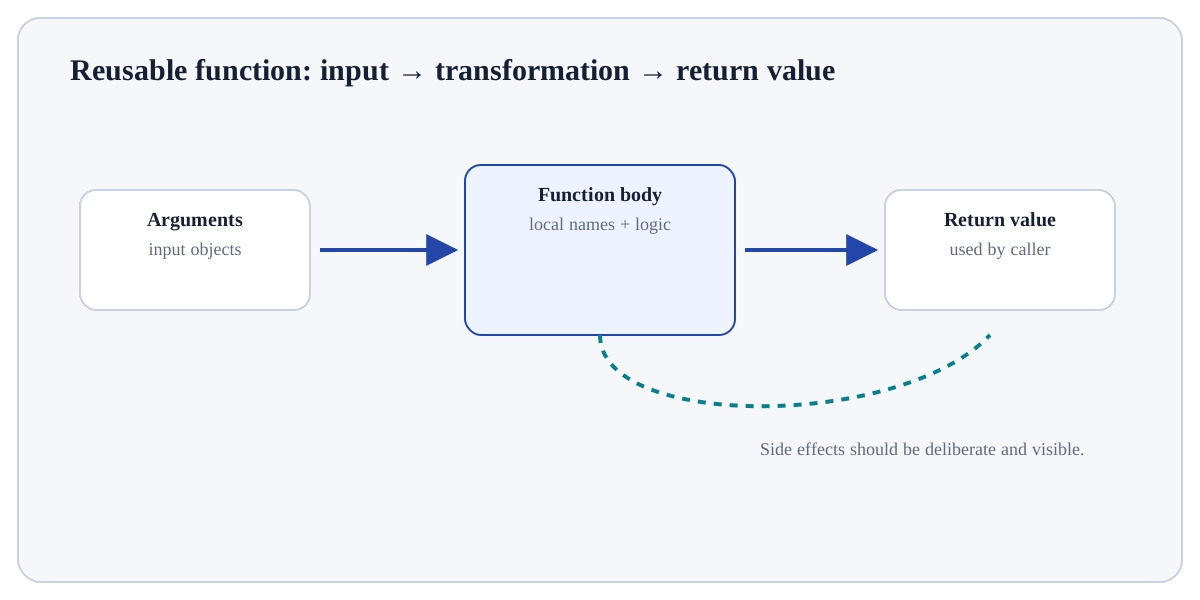
State the small task and expected result before coding. For Mini Lab Reusable KPI Functions, identify the exact state before this stage, the operation or rule applied here, and the observable state afterwards so the mechanism remains inspectable.
# Step 1 — Define the reusable `rate` function; its indented body describes what happens for each call.
def rate(numerator, denominator):
    # Step 2 — Evaluate this condition and execute the indented branch only when the condition is true.
    if denominator <= 0:
        # Step 3 — Raise an explicit exception to signal that the required condition or input contract was violated.
        raise ValueError("denominator must be positive")
    # Step 4 — Return the computed value to the caller so the result can be reused or tested.
    return numerator / denominator
# Step 5 — Display the current value explicitly so the result/state can be inspected during execution.
print(rate(25, 100))The function returns 0.25 and rejects an invalid non-positive denominator.
For Mini Lab Reusable KPI Functions, trace the specific input through the mechanism above and independently verify one returned value, state change or side effect.
InputObjects/values supplied to the operation.StateNames or mutable objects that may change during execution.OutputReturned value, side effect, file, plot or exception to inspect.Use Mini Lab Reusable KPI Functions when it answers a defined question in Functions & Reusable Code and its inputs/assumptions match the current data or program state.
Reconsider Mini Lab Reusable KPI Functions when the required information is unavailable, the operation would violate a validation/data boundary, or a simpler operation answers the question more transparently.
Construct a tiny example of Mini Lab Reusable KPI Functions. First state the small task and expected result before coding. Then use the concepts from this module rather than introducing unnecessary new machinery. Predict the result before execution and explain one boundary or failure case.
Which approach best demonstrates understanding of Mini Lab Reusable KPI Functions?
Step 1State the small task and expected result before coding.Step 2Use the concepts from this module rather than introducing unnecessary new machinery.Step 3Inspect intermediate values on the tiny example.Step 4Check at least one edge case.