Capstone: A Small Data Project · Lesson 163

Write Reusable Analysis Functions

Reusable analysis functions isolate one calculation behind explicit inputs and returned outputs so the same rule is not copied across scripts or notebooks.

ConceptWorked examplePracticeKnowledge check
Textbook walkthrough

Write Reusable Analysis Functions

Reusable analysis functions isolate one calculation behind explicit inputs and returned outputs so the same rule is not copied across scripts or notebooks.

Learning goal: explain why Write Reusable Analysis Functions behaves this way, apply it to a small example, and verify the result independently. Begin by being able to justify this first step: Give each function one responsibility, pass data/parameters explicitly, return results, add a docstring/type hints where useful and test with small inputs.

Deeper walkthrough

Read Write Reusable Analysis Functions as a mechanism, not a recipe

Treat this as a sequence of observable decisions rather than one opaque command. Stage 1: Give each function one responsibility, pass data/parameters explicitly, return results, add a docstring/type hints where useful and test with small inputs. Stage 2: Keep the stage inside the same data/validation definitions used by the rest of the project. Stage 3: Save the evidence produced by this stage so the next stage can be audited.

Mechanism

Follow the transformation

Give each function one responsibility, pass data/parameters explicitly, return results, add a docstring/type hints where useful and test with small inputs.

Keep the stage inside the same data/validation definitions used by the rest of the project.

Save the evidence produced by this stage so the next stage can be audited.

Evidence

Know what would convince you

  • Trace a tiny input by hand and compare the runtime result.
  • Inspect type, value/shape and any mutation/side effect explicitly.
Useful distinctionInput: Objects/values supplied to the operation.
Visual demonstration of Write Reusable Analysis Functions
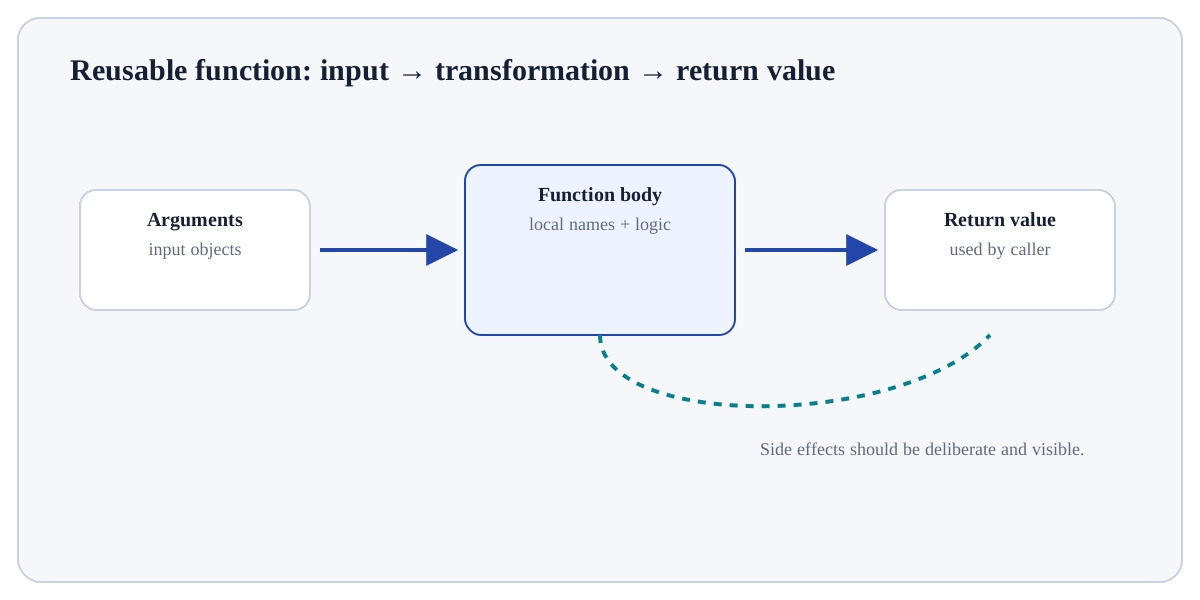
Visual demonstration: use the diagram to trace the main objects and state changes involved in Write Reusable Analysis Functions.
Click a stage to inspect what happens, what changes, and what should be checked before moving on.
Stage 1

Give each function one responsibility

Give each function one responsibility, pass data/parameters explicitly, return results, add a docstring/type hints where useful and test with small inputs.

Verification focus: record the evidence you inspected and the condition that would make this stage fail.
How it works

Trace the mechanism step by step

  1. Give each function one responsibility, pass data/parameters explicitly, return results, add a docstring/type hints where useful and test with small inputs.
  2. Keep the stage inside the same data/validation definitions used by the rest of the project.
  3. Save the evidence produced by this stage so the next stage can be audited.
Worked demonstration

Write Reusable Analysis Functions evidence

Write Reusable Analysis Functions evidence
Evidence: one function called from at least two places produces the same rule-consistent result.
Expected / illustrative result
The worked evidence makes the output of this project stage concrete and auditable.
Interpret the result.

For Write Reusable Analysis Functions, trace the specific input through the mechanism above and independently verify one returned value, state change or side effect.

Distinctions & related ideas

Place the concept correctly

InputObjects/values supplied to the operation.
StateNames or mutable objects that may change during execution.
OutputReturned value, side effect, file, plot or exception to inspect.
Use deliberately

When it is appropriate

Use Write Reusable Analysis Functions when it answers a defined question in Capstone: A Small Data Project and its inputs/assumptions match the current data or program state.

Boundary conditions

When to stop or reconsider

Reconsider Write Reusable Analysis Functions when the required information is unavailable, the operation would violate a validation/data boundary, or a simpler operation answers the question more transparently.

Common mistakes

Failure modes to recognise

  • Running the operation on the wrong object/type or in the wrong environment.
  • Inferring correctness from “no exception” without checking the produced value/state.
  • Hiding a boundary case instead of making its behaviour explicit.
Verification

How to check the result

  • Trace a tiny input by hand and compare the runtime result.
  • Inspect type, value/shape and any mutation/side effect explicitly.
  • Run an edge or invalid case and confirm the exception/behaviour is deliberate.
Hands-on practice

Demonstrate understanding

Try this:

Construct a tiny example of Write Reusable Analysis Functions. First give each function one responsibility, pass data/parameters explicitly, return results, add a docstring/type hints where useful and test with small inputs. Then keep the stage inside the same data/validation definitions used by the rest of the project. Predict the result before execution and explain one boundary or failure case.

List the stage inputs and expected artifact, rerun it from a clean state, and compare against a concrete acceptance check.
Knowledge check

Check reasoning, not memorisation

Which approach best demonstrates understanding of Write Reusable Analysis Functions?

Quick reference

Remember the logic

Step 1Give each function one responsibility, pass data/parameters explicitly, return results, add a docstring/type hints where useful and test with small inputs.
Step 2Keep the stage inside the same data/validation definitions used by the rest of the project.
Step 3Save the evidence produced by this stage so the next stage can be audited.
Lesson summary

What to remember

  • Reusable analysis functions isolate one calculation behind explicit inputs and returned outputs so the same rule is not copied across scripts or notebooks.
  • Give each function one responsibility, pass data/parameters explicitly, return results, add a docstring/type hints where useful and test with small inputs.
  • Running the operation on the wrong object/type or in the wrong environment.
  • Trace a tiny input by hand and compare the runtime result.