How does a network turn many simple transformations into complex behaviour?
Start here
How does a network turn many simple transformations into complex behaviour?
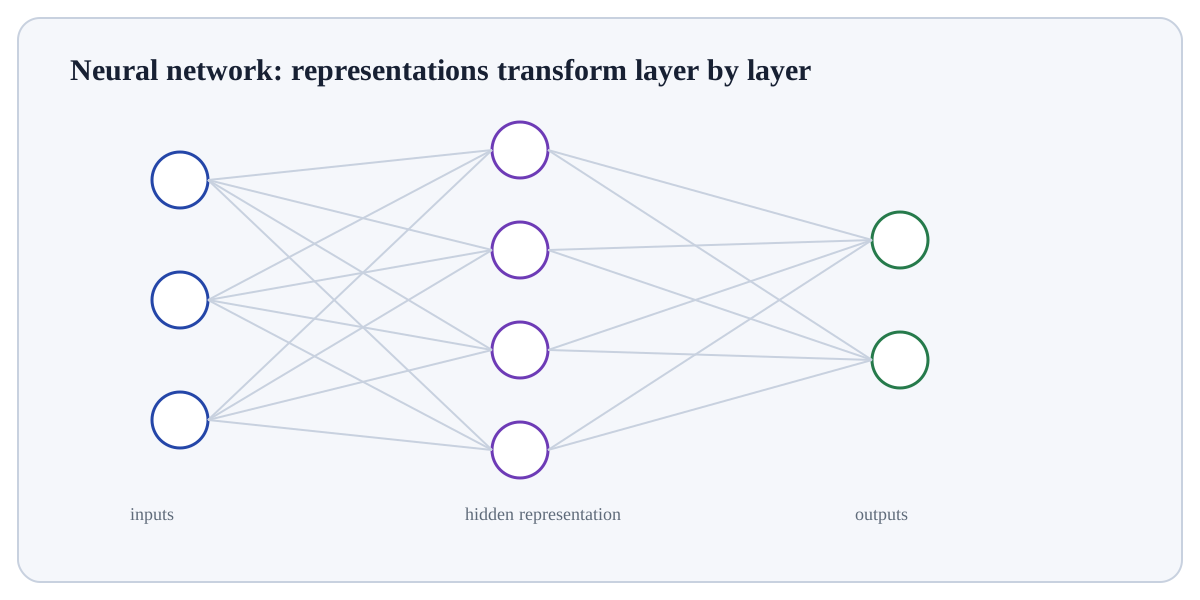
A neural network composes affine transformations and nonlinear activations. Training adjusts weights so the final outputs reduce a loss function.
Building interactive view…
Understand
Build the mental model
A neural network composes affine transformations and nonlinear activations. Training adjusts weights so the final outputs reduce a loss function. Monitor training/validation curves, scale inputs, tune learning rate carefully and use regularisation/normalisation where appropriate.
Click a stage to inspect what happens, what changes, and what should be checked before moving on.
Stage 1
Forward pass
For the “Forward pass” stage, identify the incoming object, the rule applied to it, the state change produced, and the evidence that would reveal a mistake. Technical context for Neural Networks & Backpropagation: Backpropagation applies the chain rule to compute gradients efficiently through the computational graph; an optimiser uses those gradients to update parameters.
Practitioner checkpoint: Monitor training/validation curves, scale inputs, tune learning rate carefully and use regularisation/normalisation where appropriate.
What happens if…?
Break the assumption deliberately
Increase learning rate until loss oscillates or diverges.
Move the control and explain what you expect before reading the visual.
Technical lens
Formalise what the visual is doing
Backpropagation applies the chain rule to compute gradients efficiently through the computational graph; an optimiser uses those gradients to update parameters.
Technical questionUse a tiny case to make the mechanism observable. Backpropagation applies the chain rule to compute gradients efficiently through the computational graph; an optimiser uses those gradients to update parameters. Verify one intermediate quantity, state change or mapping independently; then predict the consequence of this change: Increase learning rate until loss oscillates or diverges.
Practitioner lens
Use it responsibly
Monitor training/validation curves, scale inputs, tune learning rate carefully and use regularisation/normalisation where appropriate.
Transfer testTransfer this idea to a new example and justify each decision using this practitioner rule: Monitor training/validation curves, scale inputs, tune learning rate carefully and use regularisation/normalisation where appropriate. Then explain what should change if you deliberately test: Increase learning rate until loss oscillates or diverges.
Worked exploration
Use the visual as an experiment, not decoration
Use one neuron z = wx+b followed by an activation. Chain two layers, compute a loss, then conceptually propagate gradients backward so each weight receives a direction for reducing the loss.
Technical lens
Backpropagation applies the chain rule to compute gradients efficiently through the computational graph; an optimiser uses those gradients to update parameters.
Practitioner check
Monitor training/validation curves, scale inputs, tune learning rate carefully and use regularisation/normalisation where appropriate.
Prediction before interaction
Increase learning rate until loss oscillates or diverges.
Exploration walkthrough
Turn the interaction into an evidence trail
Use one neuron z = wx+b followed by an activation. Chain two layers, compute a loss, then conceptually propagate gradients backward so each weight receives a direction for reducing the loss. Before moving the control, state your prediction. After the visual changes, name the specific state, statistic, boundary or mapping that changed and explain why that change is consistent—or inconsistent—with your prediction.
Record one observable quantity before the interaction and the same quantity afterwards.
Change one factor at a time so the causal effect of the control is inspectable.
Use an edge or failure case to discover where the concept stops behaving as the simple story suggests.
Static orientation diagram for Neural Networks & Backpropagation; use the interactive visual above to test how the relationships change.
Reference depth
Open the complete material
The flagship experience is the map. These pages contain the roads.