How can a sequence of weak models repair its own mistakes?
Start here
How can a sequence of weak models repair its own mistakes?
Boosting adds learners sequentially. Each new learner focuses on the residual error or gradient left by the current ensemble.
Building interactive view…
Understand
Build the mental model
Boosting adds learners sequentially. Each new learner focuses on the residual error or gradient left by the current ensemble. Use careful validation and monitor training rounds. Lower learning rates often require more trees.
Click a stage to inspect what happens, what changes, and what should be checked before moving on.
Stage 1
Current prediction
Inspect the observable result and its meaning. Check type/shape/range and distinguish a model score or intermediate value from the final decision made from it. Technical context for Gradient Boosting: Gradient boosting performs stage-wise functional optimisation. Learning rate controls step size; tree depth controls interaction complexity; early stopping regulates overfit.
Practitioner checkpoint: Use careful validation and monitor training rounds. Lower learning rates often require more trees.
What happens if…?
Break the assumption deliberately
Set learning rate very high and watch the ensemble overshoot useful corrections.
Move the control and explain what you expect before reading the visual.
Technical lens
Formalise what the visual is doing
Gradient boosting performs stage-wise functional optimisation. Learning rate controls step size; tree depth controls interaction complexity; early stopping regulates overfit.
Technical questionUse a tiny case to make the mechanism observable. Gradient boosting performs stage-wise functional optimisation. Learning rate controls step size; tree depth controls interaction complexity; early stopping regulates overfit. Verify one intermediate quantity, state change or mapping independently; then predict the consequence of this change: Set learning rate very high and watch the ensemble overshoot useful corrections.
Practitioner lens
Use it responsibly
Use careful validation and monitor training rounds. Lower learning rates often require more trees.
Transfer testLarge learning rate plus deep trees causing overfit/instability.
Worked exploration
Use the visual as an experiment, not decoration
Begin with a constant prediction, calculate residual-like errors, fit a shallow tree to those errors, and add a small fraction of its prediction. Repeat and watch the loss decrease stage by stage.
Technical lens
Gradient boosting performs stage-wise functional optimisation. Learning rate controls step size; tree depth controls interaction complexity; early stopping regulates overfit.
Practitioner check
Use careful validation and monitor training rounds. Lower learning rates often require more trees.
Prediction before interaction
Set learning rate very high and watch the ensemble overshoot useful corrections.
Exploration walkthrough
Turn the interaction into an evidence trail
Begin with a constant prediction, calculate residual-like errors, fit a shallow tree to those errors, and add a small fraction of its prediction. Repeat and watch the loss decrease stage by stage. Before moving the control, state your prediction. After the visual changes, name the specific state, statistic, boundary or mapping that changed and explain why that change is consistent—or inconsistent—with your prediction.
Record one observable quantity before the interaction and the same quantity afterwards.
Change one factor at a time so the causal effect of the control is inspectable.
Use an edge or failure case to discover where the concept stops behaving as the simple story suggests.
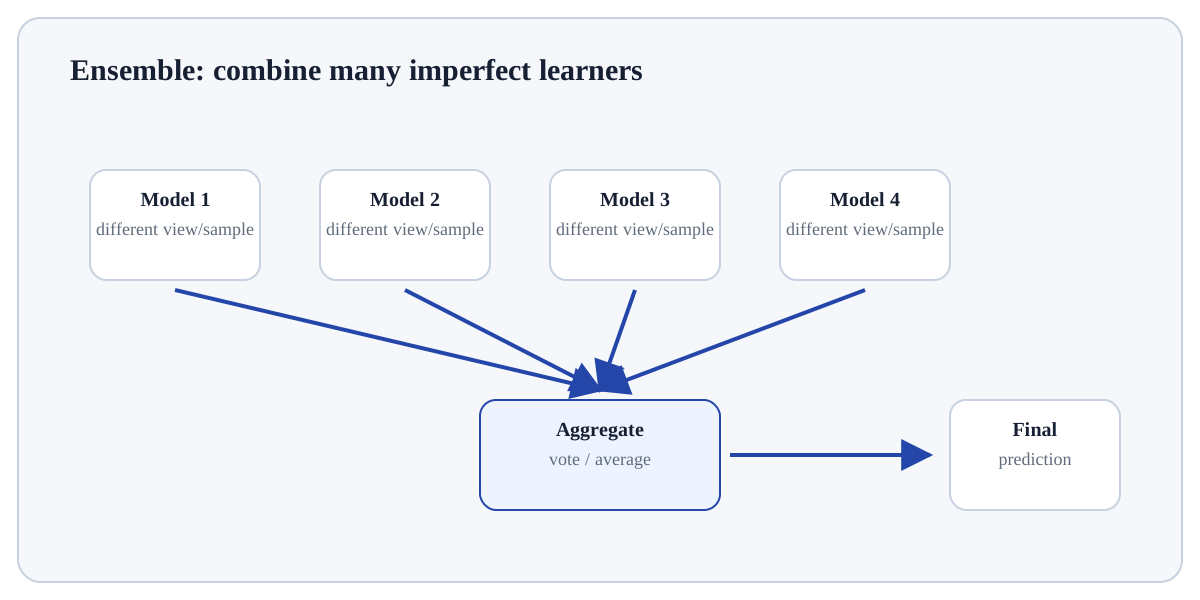
Static orientation diagram for Gradient Boosting; use the interactive visual above to test how the relationships change.
Reference depth
Open the complete material
The flagship experience is the map. These pages contain the roads.