How does a tree convert questions into regions of feature space?
Start here
How does a tree convert questions into regions of feature space?
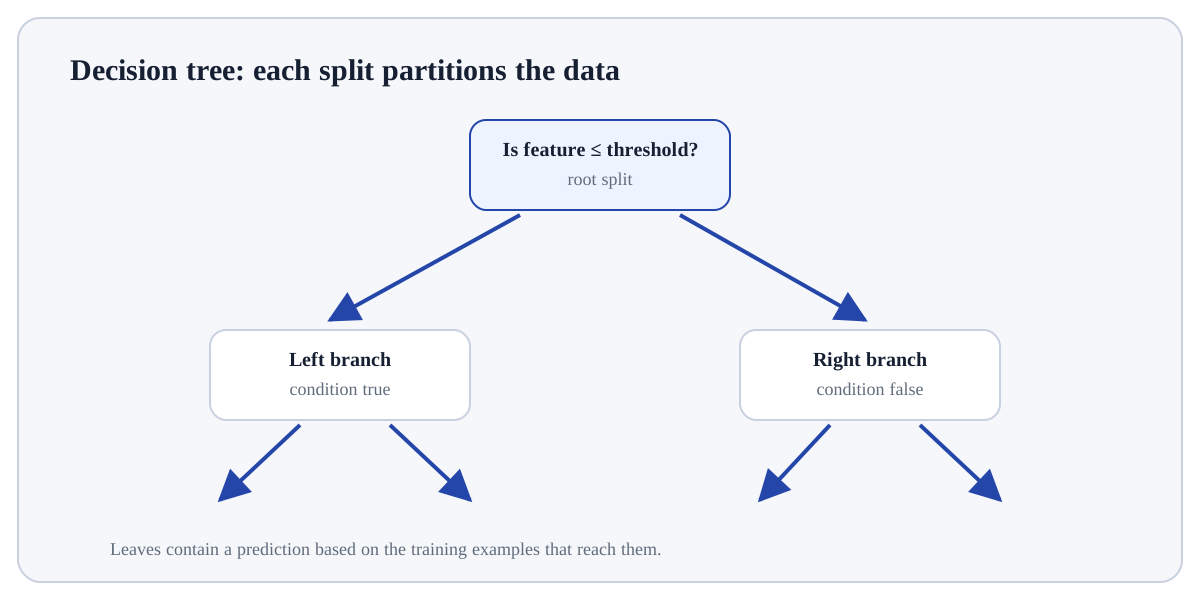
A decision tree recursively asks threshold questions that make child groups more homogeneous. Each path is an explicit rule from root to leaf.
Building interactive view…
Understand
Build the mental model
A decision tree recursively asks threshold questions that make child groups more homogeneous. Each path is an explicit rule from root to leaf. Trees are interpretable but unstable. Use pruning/regularisation and compare with ensembles when predictive stability matters.
Click a stage to inspect what happens, what changes, and what should be checked before moving on.
Stage 1
Candidate split
This is a learning/estimation stage. Separate the data supplied to the algorithm from the parameters or structure it learns, and keep validation information outside the fit. Technical context for Decision Trees: Classification trees optimise impurity reduction; regression trees reduce squared error or related criteria. Depth/min-samples constraints regulate variance.
Practitioner checkpoint: Trees are interpretable but unstable. Use pruning/regularisation and compare with ensembles when predictive stability matters.
What happens if…?
Break the assumption deliberately
Increase maximum depth until training error collapses while validation error worsens.
Move the control and explain what you expect before reading the visual.
Technical lens
Formalise what the visual is doing
Classification trees optimise impurity reduction; regression trees reduce squared error or related criteria. Depth/min-samples constraints regulate variance.
Technical questionUse a tiny case to make the mechanism observable. Classification trees optimise impurity reduction; regression trees reduce squared error or related criteria. Depth/min-samples constraints regulate variance. Verify one intermediate quantity, state change or mapping independently; then predict the consequence of this change: Increase maximum depth until training error collapses while validation error worsens.
Practitioner lens
Use it responsibly
Trees are interpretable but unstable. Use pruning/regularisation and compare with ensembles when predictive stability matters.
Transfer testTransfer this idea to a new example and justify each decision using this practitioner rule: Trees are interpretable but unstable. Use pruning/regularisation and compare with ensembles when predictive stability matters. Then explain what should change if you deliberately test: Increase maximum depth until training error collapses while validation error worsens.
Worked exploration
Use the visual as an experiment, not decoration
Use one feature with low values mostly class 0 and high values mostly class 1. Evaluate candidate split thresholds and see how impurity decreases. Grow deeper and observe how increasingly specific regions can overfit.
Technical lens
Classification trees optimise impurity reduction; regression trees reduce squared error or related criteria. Depth/min-samples constraints regulate variance.
Practitioner check
Trees are interpretable but unstable. Use pruning/regularisation and compare with ensembles when predictive stability matters.
Prediction before interaction
Increase maximum depth until training error collapses while validation error worsens.
Exploration walkthrough
Turn the interaction into an evidence trail
Use one feature with low values mostly class 0 and high values mostly class 1. Evaluate candidate split thresholds and see how impurity decreases. Grow deeper and observe how increasingly specific regions can overfit. Before moving the control, state your prediction. After the visual changes, name the specific state, statistic, boundary or mapping that changed and explain why that change is consistent—or inconsistent—with your prediction.
Record one observable quantity before the interaction and the same quantity afterwards.
Change one factor at a time so the causal effect of the control is inspectable.
Use an edge or failure case to discover where the concept stops behaving as the simple story suggests.
Static orientation diagram for Decision Trees; use the interactive visual above to test how the relationships change.
Reference depth
Open the complete material
The flagship experience is the map. These pages contain the roads.